

Talk to almost any restaurant owner right now and you’ll probably hear the same thing.
Food isn’t getting any cheaper.
One week chicken jumps. The next week it’s cooking oil, produce, or paper goods. You finally get one cost under control and something else decides to climb.
You can’t control the market, but you can control how you buy.
That’s where wholesale food buying starts making a real difference. It isn’t about buying the biggest case of everything or chasing whichever distributor has the lowest price this week. It’s about creating a purchasing strategy that keeps your food costs steady, your shelves stocked, and your kitchen running without constant surprises.
The good news? You don’t have to overhaul your entire operation to start saving money. A few smarter purchasing habits can go a long way.
What Is Wholesale Food Buying?
Wholesale food buying simply means purchasing the products your restaurant needs directly through foodservice distributors or wholesalers instead of buying them at retail stores.
If you’ve ever grabbed an emergency case of tomatoes from a warehouse club because your delivery didn’t show up, you’ve seen both sides of it.
Retail stores are great in a pinch.
They’re just not built for restaurants.
Wholesale suppliers work differently. Their business revolves around keeping restaurants supplied with the products they order every week. That usually means larger case sizes, commercial packaging, scheduled deliveries, and pricing that’s designed for businesses instead of individual shoppers.
Most restaurants buy things like:
- Fresh produce
- Meat and seafood
- Dairy products
- Frozen foods
- Dry goods
- Paper products
- Cleaning supplies
- Beverages
through wholesale distributors because it’s simply a more efficient way to operate.
The goal isn’t just spending less.
It’s buying consistently enough that your food costs don’t feel like they’re changing every time you open an invoice.
Why Wholesale Food Buying is Critical for Restaurants
Margins are tight.
They’ve always been tight, but lately there’s even less room for mistakes.
Paying an extra few cents for one ingredient doesn’t sound like much until you realize you’re ordering that ingredient every single week. Multiply that across dozens of products, multiple deliveries, and an entire year, and suddenly you’re wondering where your profits went.
That’s why purchasing deserves just as much attention as menu pricing or labor scheduling.
Restaurants that treat purchasing like a business strategy usually have an easier time:
- Keeping food costs under control
- Planning inventory with fewer surprises
- Reducing expensive last-minute purchases
- Building stronger relationships with suppliers
- Protecting profit margins when prices fluctuate
Notice that none of those things have anything to do with buying the cheapest product.
Because that’s rarely the answer.
The restaurants that consistently perform well usually aren’t winning because they found one incredible deal. They’re winning because they have a process. They know what they’re buying, who they’re buying it from, and whether they’re actually getting good value.
That consistency is what makes wholesale food buying so important.
Difference Between Wholesale and Retail Food Purchasing
Both wholesale and retail suppliers sell food.
That’s where the similarities pretty much end.
Think about the last time you walked into a grocery store because you needed something for tonight’s dinner service. You probably paid more than usual, bought whatever brand was available, and spent time driving there that you didn’t really have.
Sometimes that’s unavoidable.
Doing it every week gets expensive.
Wholesale purchasing is built around how restaurants actually operate.
Instead of shopping aisle by aisle, you’re placing recurring orders with suppliers who understand your business. Deliveries arrive on a schedule. Products are packaged for commercial kitchens. Pricing is generally more competitive because you’re buying as a business instead of as a consumer.
Here’s a quick comparison.
| Wholesale Buying | Retail Buying |
|---|---|
| Business pricing | Consumer pricing |
| Commercial case sizes | Smaller packages |
| Scheduled deliveries | Pick it up yourself |
| Restaurant-focused inventory | Consumer selection |
| Opportunities for rebates and negotiated pricing | Limited savings opportunities |
The Biggest Challenges Restaurants Face When Buying Food Wholesale
Buying wholesale should make running a restaurant easier.
Sometimes it does.
Other times, it feels like you’re playing a game where the rules change every week.
One invoice looks great, the next one has half a dozen price increases you weren’t expecting. A product you’ve ordered for years suddenly goes out of stock. Your walk-in is packed with food that isn’t moving fast enough while you’re scrambling to replace something that didn’t show up on the truck.
Sound familiar?
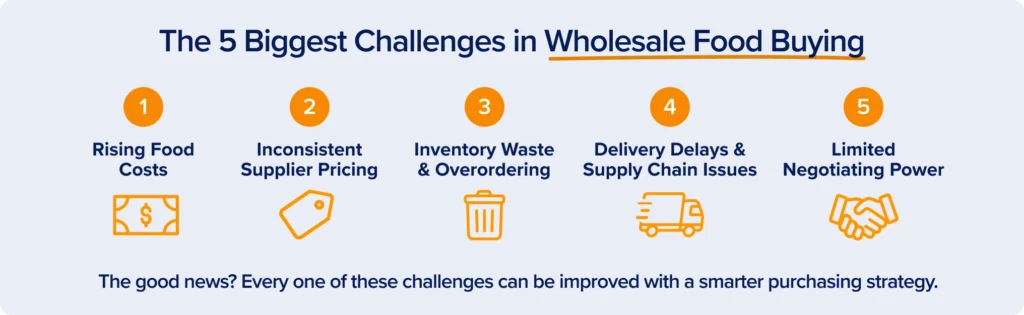
Most restaurants run into the same handful of purchasing challenges. The good news is that once you know where they come from, they’re a lot easier to manage.
Rising Food Costs and Inflation Pressure
Food prices don’t stay still for very long.
One season it’s eggs. Then beef climbs. Produce gets hit by bad weather, transportation costs increase, or supply becomes limited. Before you know it, your food costs are creeping up even though your menu hasn’t changed.
The tricky part is that these increases rarely happen all at once. They’re usually small enough to go unnoticed until they’ve piled up across dozens of products.
That’s why many operators review invoices every week instead of assuming prices will stay the same month after month.
Small increases have a way of turning into big surprises.
Inconsistent Supplier Pricing
Have you ever looked at two invoices for the exact same product and wondered why the price changed?
You’re not alone.
Supplier pricing can fluctuate for a lot of reasons. Market conditions change. Promotions expire. Contract pricing ends. Even buying from multiple distributors without regularly comparing costs can lead to paying more than necessary.
That doesn’t mean you need to chase the lowest price every week.
It does mean it’s worth checking that you’re still getting competitive pricing, especially on the products you buy over and over again.
The ingredients you order every week usually have the biggest impact on your overall food costs.
Inventory Waste and Overordering
Nobody likes running out of food during service.
But ordering too much creates a different problem.
Extra inventory ties up cash, takes up valuable storage space, and increases the chances that products expire before they’re ever used. Fresh ingredients are especially risky because they have a limited shelf life.
Finding the right balance takes practice.
Many restaurants have better luck ordering based on sales trends instead of guesswork. Looking at what actually sold last week is usually a better starting point than simply ordering what you ordered before.
Delivery Delays and Supply Chain Issues
Even the best purchasing plan can fall apart if products don’t arrive when they’re supposed to.
Late deliveries, backordered items, and product substitutions can force restaurants into making expensive last-minute purchases just to get through service.
Most operators have experienced it.
You plan your weekend specials around one product, then Friday morning rolls around and your supplier tells you it’s unavailable.
Having a backup plan, building relationships with dependable distributors, and avoiding last-minute ordering whenever possible can help reduce those headaches when supply chain issues pop up.
Limited Negotiating Power
Independent restaurants often face one challenge that large chains don’t.
Buying power.
National restaurant brands purchase enormous volumes of food, which often gives them access to pricing and contract terms that smaller operators can’t negotiate on their own.
That doesn’t mean independent restaurants are stuck paying higher prices forever.
Many operators improve their purchasing power by working with organizations like Dining Alliance, which helps independent restaurants access competitive pricing, cash-back rebates, and supplier programs that would normally be difficult to secure on their own.
It’s one of the simplest ways to level the playing field without having to increase your purchasing volume.
How Restaurants Can Get Better Prices on Wholesale Food
Getting better wholesale pricing isn’t about finding one supplier with the lowest prices and calling it a day.
The restaurants that consistently keep food costs under control usually have something else in common: they have a purchasing strategy.
They know what they’re buying, they pay attention to pricing trends, and they make adjustments before rising costs start eating into their margins.
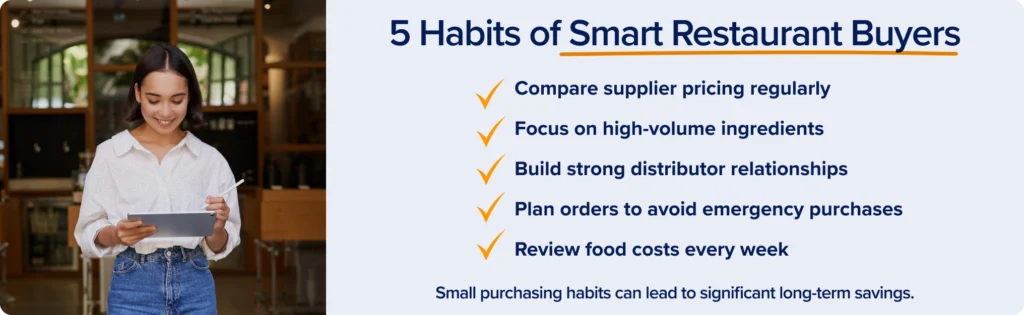
Here are a few habits that can make a real difference.
Compare Multiple Food Suppliers Regularly
It’s easy to stick with the same supplier year after year. After all, you know their ordering process, your sales rep knows your business, and changing suppliers can feel like more trouble than it’s worth.
But prices change.
Supplier programs change.
Contract terms change.
That doesn’t mean you should switch distributors every few months. It simply means it’s smart to check in from time to time and make sure you’re still getting competitive pricing on the products you buy most often.
Even comparing a handful of your highest-volume items can uncover savings opportunities you didn’t know existed.
Buy High-Volume Ingredients Strategically
Not every item on your order guide deserves the same level of attention.
Focus first on the products you purchase week after week.
Think proteins, cooking oils, dairy products, flour, frozen potatoes, beverages, or whatever makes up the bulk of your menu. Saving a few cents on an ingredient you order once a month won’t move the needle very much.
Saving that same amount on something you buy every single week can add up surprisingly fast over the course of a year.
When you’re looking for ways to lower food costs, start with the items that have the biggest impact on your purchasing budget.
Build Strong Relationships With Distributors
A good distributor is more than someone who delivers your food.
The best supplier relationships can help you stay ahead of price increases, identify alternative products when items are unavailable, and uncover programs that could reduce your costs.
The more your distributor understands your operation, the better they can help you make purchasing decisions that fit your business.
At the same time, it never hurts to ask questions.
Ask about contract pricing.
Ask about seasonal opportunities.
Ask if there are manufacturer promotions or rebate programs available.
Sometimes the biggest savings come from simply starting the conversation.
Order Smarter to Reduce Last-Minute Purchases
Emergency grocery runs are expensive.
We’ve all done them.
You realize halfway through lunch that you’re out of an ingredient, someone jumps in the car, and suddenly you’re paying retail prices because you don’t have another option.
Those moments happen, but they shouldn’t become routine.
Using sales history to forecast demand, keeping inventory counts up to date, and placing orders a little earlier can help reduce those costly last-minute purchases.
A little planning usually costs far less than scrambling to fix a problem during service.
Track Food Costs Weekly Instead of Monthly
Waiting until the end of the month to review food costs can leave you playing catch-up.
By then, you’ve already absorbed weeks of price increases, overordered inventory, or purchased products that cost more than expected.
A weekly review gives you the chance to spot trends early.
Maybe the price of chicken has climbed for three weeks in a row. Maybe one supplier has quietly increased pricing on several high-volume items. Or maybe a menu item isn’t delivering the profit you thought it was.
Those are much easier problems to solve when you catch them quickly.
One more thing worth looking at? Whether you’re taking advantage of the purchasing power available to you.
Many independent restaurants join a group purchasing organization (GPO) like Dining Alliance to gain access to negotiated pricing, cash-back rebates, and manufacturer programs that would be difficult to secure on their own. Instead of negotiating as a single restaurant, you’re able to benefit from the combined buying power of thousands of operators.
For many restaurants, that’s one of the easiest ways to improve wholesale food buying without completely changing suppliers or overhauling their operation.
Why Bulk Purchasing Alone Doesn’t Always Save Money
Buying in bulk can absolutely lower your cost per unit.
But here’s the catch.
Saving money on paper doesn’t always translate into saving money in your restaurant.
If you’re throwing products away, storing inventory you don’t have room for, or ordering more than your kitchen can realistically use, those “savings” disappear pretty quickly.
The goal isn’t to buy the most food. It’s to buy the right amount of food at the best possible value.
The Hidden Cost of Food Waste
Let’s say you save 15% by buying an extra case of produce.
Sounds like a win.
Now imagine half of it spoils before it ever makes it onto a customer’s plate.
Suddenly, that discount doesn’t look so impressive.
Food waste is one of the biggest hidden expenses in restaurant purchasing because it often goes unnoticed. Products expire, ingredients get forgotten in the walk-in, or menu demand changes and inventory sits longer than expected.
The less food you throw away, the more value you get from every dollar you spend.
Sometimes ordering a little less actually saves more.
Storage and Shelf-Life Challenges
Every restaurant has limits.
Only so much fits in the walk-in, freezer, and dry storage before things become difficult to organize.
When storage areas get overcrowded, it’s easier for products to get buried behind newer deliveries or overlooked altogether. That can lead to expired inventory, duplicate orders, and employees grabbing whatever’s easiest instead of what’s been sitting there the longest.
Before increasing order sizes, ask yourself a simple question:
Do we actually have the space to store this properly?
If the answer is no, buying more probably isn’t the best deal.
Poor Inventory Management
Bulk purchasing works best when it’s backed by solid inventory practices.
Without regular inventory counts and a good understanding of what you’re using each week, it’s easy to order products you already have or miss slow-moving inventory that’s been sitting on the
“`html
shelf for weeks.
A few simple habits can make a big difference:
- Count inventory on a consistent schedule.
- Rotate products using the first in, first out (FIFO) method.
- Review sales trends before placing large orders.
- Adjust purchasing based on seasonal demand instead of habit.
- Keep your order guide up to date as your menu changes.
Bulk purchasing should support your operation, not complicate it.
When you combine smart inventory management with strategic wholesale food buying, you’re much more likely to see real savings instead of simply buying more food than you need.
How to Choose the Right Wholesale Food Supplier
Finding the right wholesale food supplier isn’t just about who has the lowest prices this week.
Think about it this way. The supplier you choose has a hand in your food costs, inventory levels, delivery schedule, and even your guests’ experience. If they’re reliable, your kitchen runs a little smoother. If they’re not, you’re the one scrambling five minutes before prep starts.
So before signing on the dotted line, it’s worth looking beyond the price list.
National vs Local Food Suppliers
There’s no clear winner here because every restaurant is different.
National distributors are often a great fit for the products you order every week. They typically offer larger inventories, dependable delivery schedules, and competitive pricing on high-volume items. Many also provide access to manufacturer contracts and rebate programs that can help lower your overall food costs.
Local suppliers, on the other hand, bring a different kind of value. They may offer fresher seasonal ingredients, specialty products you can’t find elsewhere, and a more personal level of service. If your menu highlights locally sourced ingredients, building relationships with regional vendors can help set your restaurant apart.
For many operators, it doesn’t have to be one or the other.
Using a national distributor for your everyday staples while sourcing select ingredients locally often gives you the best of both worlds.
If you’re interested in adding more local products to your menu, check out this guide to regional sourcing for restaurants to learn how regional supplier programs can help you source fresher ingredients while simplifying purchasing.
Pricing Structures and Contract Terms
Don’t stop at comparing prices.
Two suppliers may quote similar costs, but the overall value can look very different once you dig into the details.
Before making a decision, take a closer look at things like:
- How often prices are updated
- Whether pricing is contract-based or tied to market fluctuations
- Minimum order requirements
- Delivery fees or fuel surcharges
- Payment terms
- Available manufacturer rebates or incentive programs
Sometimes the supplier with the slightly higher invoice actually delivers more value once rebates, consistent pricing, and reliable service are factored in.
This is also where a group purchasing organization (GPO) like Dining Alliance can help. By combining the purchasing power of thousands of independent restaurants, GPOs help members access negotiated pricing and rebate opportunities that may not be available when buying on their own.
Questions Restaurants Should Ask Before Choosing a Supplier
Choosing a supplier is a business decision, so don’t be afraid to ask plenty of questions before committing.
A reputable distributor should be happy to walk you through how they work and explain what you can expect after you become a customer.
Here are a few questions worth asking:
- How often do prices change?
- What happens if a product is out of stock?
- How are substitutions handled?
- What are your delivery days and order deadlines?
- Do you offer manufacturer rebates or contract pricing?
- Will I have a dedicated sales representative?
- How quickly do you resolve delivery or pricing issues?
- Can you provide references from other restaurant customers?
The answers will tell you just as much as the price sheet.
At the end of the day, the right wholesale food supplier should help your restaurant operate more efficiently, not create more work. Consistent deliveries, fair pricing, responsive service, and programs that help lower costs are all signs you’ve found a supplier worth keeping around.
Common Food Buying Mistakes Restaurants Make
Nobody gets every purchasing decision right.
Even experienced operators make mistakes from time to time. The difference is that small purchasing habits can quietly add up over weeks and months, making it harder to keep food costs under control.
Here are a few of the most common mistakes to watch for.
Buying Based Only on Price
Everyone wants to save money.
But the lowest price doesn’t always deliver the best value.
Maybe that cheaper product isn’t as consistent. Maybe deliveries are unreliable. Or maybe your kitchen ends up wasting more because the quality isn’t what you’re used to.
It’s worth looking at the bigger picture.
Ask yourself questions like:
- Is the product consistent?
- Does it perform the way my kitchen expects?
- Is the supplier reliable?
- Will this purchase actually lower my overall food costs?
Sometimes paying a little more upfront saves you money in the long run.
Ignoring Rebate Opportunities
One of the easiest ways to miss out on savings is by overlooking manufacturer rebates.
Many restaurants don’t realize they’re already buying products that qualify for cash-back rebates. If those programs aren’t part of your purchasing strategy, you’re leaving money on the table.
That’s one reason many independent operators join a group purchasing organization (GPO) like Dining Alliance. In addition to negotiated pricing, members can earn rebates on qualifying purchases, helping reduce food costs without changing what’s already on the menu.
If you’re not asking about rebates, it’s worth starting the conversation with your supplier.
Ordering Without Forecasting Demand
Ordering based on instinct can work for a while.
But as your restaurant gets busier, it becomes much harder to predict what you’ll need without looking at the numbers.
Sales reports, seasonal trends, upcoming events, and even the weather can all affect how much product you’ll use.
Taking a few minutes to review recent sales before placing an order can help you avoid two expensive problems:
- Running out of popular ingredients.
- Ordering so much that products expire before they’re used.
A little forecasting goes a long way toward reducing waste and protecting your margins.
Failing to Compare Supplier Agreements
It’s easy to assume your current supplier is still offering the best deal.
But if you haven’t reviewed your supplier agreements in a while, you may not know what opportunities you’re missing.
Comparing suppliers isn’t just about finding a lower price on a few products. It’s also about evaluating contract terms, delivery schedules, rebate programs, service levels, and even different sourcing options.
For example, some restaurants combine a national distributor with regional suppliers to improve product freshness and flexibility while still keeping costs under control. If you’re exploring that approach, the Buyers Edge Platform guide to regional sourcing for restaurants explains how regional supplier programs can complement your overall purchasing strategy.
The bottom line? Reviewing your supplier relationships every so often helps ensure they’re still supporting your business-not just delivering your orders.
Best Practices for Smarter Food Purchasing
There’s no magic formula for lowering food costs.
The restaurants that consistently keep costs in check usually aren’t doing one thing differently. They’re doing a lot of little things well.
Over time, those habits add up to fewer surprises, less waste, and healthier profit margins.
Here are a few best practices worth making part of your routine.
Monitor Purchasing Performance Regularly
Don’t wait until the end of the month to see how you’re doing.
By then, the money’s already been spent.
Instead, set aside a little time each week to review your purchasing. Compare invoices, watch for price increases on your highest-volume items, and keep an eye on products that seem to be costing more than usual.
You don’t need to analyze every line item.
Focus on the products that have the biggest impact on your food costs first. That’s where you’ll usually find your biggest opportunities to save.
Standardize Recipes and Portion Sizes
If every cook prepares the same dish a little differently, your inventory won’t last as long as you expect.
One extra ounce of protein here.
A handful of fries there.
It doesn’t seem like much during a busy shift, but across hundreds of orders, those small differences can significantly increase food costs.
Standardized recipes and portion sizes help create consistency for both your guests and your budget. Every plate looks the way it’s supposed to, and your purchasing becomes much easier to predict.
It’s a win on both sides of the pass.
Train Staff to Reduce Kitchen Waste
Your purchasing strategy doesn’t stop once the delivery truck leaves.
What happens in the kitchen matters just as much.
Simple habits like rotating inventory, storing products correctly, and using ingredients before they expire can make a noticeable difference over time.
Make food waste part of the conversation with your team.
Encourage staff to report damaged products, use the oldest inventory first, and pay attention to portion sizes during prep and service.
When everyone understands that reducing waste protects the restaurant’s profitability, those small daily decisions start adding up.
Forecast Demand More Accurately
Ordering based on last week’s order isn’t always the best plan.
A holiday weekend, local festival, catering event, or even a stretch of bad weather can change customer traffic in a hurry.
Before placing your next order, take a few minutes to look at what’s coming up.
Ask yourself:
- What’s been selling well lately?
- Are there any events that could increase or decrease traffic?
- Have any menu items become more or less popular?
- Are there seasonal ingredients we’ll need more of?
The more accurate your forecast, the easier it becomes to order the right amount of inventory without tying up cash in products that sit on the shelf.
Focus on Profitable Menu Items
Not every menu item contributes equally to your bottom line.
Some dishes naturally deliver stronger margins because ingredient costs are lower or the ingredients can be used across multiple recipes.
That doesn’t mean you should eliminate customer favorites just because they cost more.
Instead, take a close look at which menu items are both popular and profitable. Those are often the dishes worth promoting through specials, server recommendations, or featured placements on your menu.
Smarter purchasing and smarter menu decisions go hand in hand.
When you know which dishes are driving profits, you can buy more strategically, reduce unnecessary inventory, and make every food dollar work a little harder.
How GPOs Help Restaurants Get Better Wholesale Prices
At some point, most independent restaurant owners run into the same problem.
You can negotiate with suppliers, compare prices, and tighten up your inventory management, but there’s only so much buying power one restaurant has on its own.
That’s where a group purchasing organization (GPO) comes in.
A GPO brings together thousands of restaurants to negotiate better pricing with manufacturers and suppliers. Instead of purchasing as a single restaurant, you benefit from the combined purchasing power of a much larger network.
For many independent operators, that means access to savings that would be difficult to secure on their own.
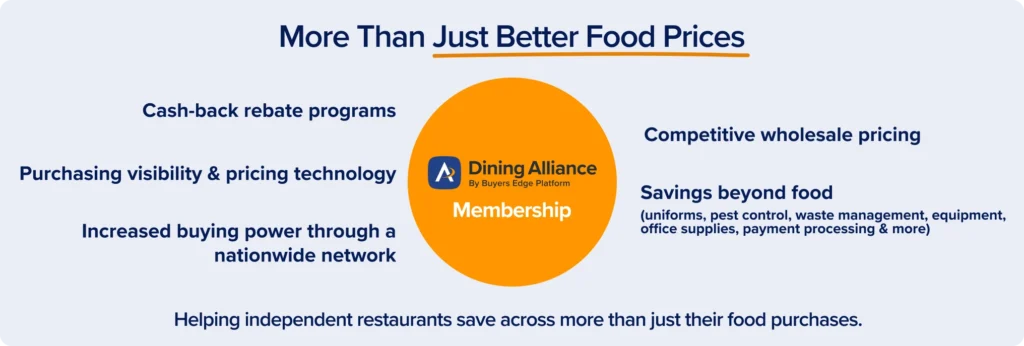
With Dining Alliance, those benefits go beyond simply paying less for food.
Members can take advantage of:
- Competitive pricing through a nationwide network of foodservice suppliers.
- Cash-back programs that reward qualifying purchases from participating manufacturers.
- Savings beyond the broadline distributor, including programs for services like uniforms, waste management, pest control, smallwares, office supplies, equipment, credit card processing, and more.
- Technology that provides greater visibility into purchasing, making it easier to review pricing, monitor spending, and identify opportunities to save.
The goal isn’t to overhaul the way you buy food.
It’s to help you make every purchasing dollar go a little further while giving you better visibility into where your money is actually going.
When you combine smarter purchasing habits with the buying power and resources of a GPO, reducing food costs becomes much more achievable.
Final Words
Wholesale food buying isn’t about chasing the lowest price every time you place an order.
The restaurants that consistently protect their margins take a more balanced approach. They compare suppliers, watch food costs closely, forecast demand, minimize waste, and look for every opportunity to get more value from the products they’re already buying.
Small improvements can make a big difference over time.
Whether you’re reviewing supplier agreements, improving inventory management, or exploring the benefits of working with a GPO, every step you take toward smarter purchasing helps strengthen your bottom line.
Ready to make your purchasing dollars work harder?
Sign up for Dining Alliance and learn how you can access competitive wholesale pricing, cash-back rebates, and additional savings programs designed specifically for independent restaurants.