


Let’s be honest: nobody gets into the restaurant business because they love logistics. You opened your doors because you love food, hospitality, and the buzz of a busy shift. But if you’ve spent any time managing a kitchen lately, you know that what happens at the back door determines whether you actually make a profit at the front of the house.
The restaurant supply chain is the invisible engine of your operation. When it runs smoothly, you don’t think about it. But when a truck is late, prices spike, or your distributor shorts a key ingredient, you’re instantly in the weeds. In today’s market, building a resilient, cost-effective supply chain isn’t just a corporate buzzword; it’s survival for the independent operator.
What Is a Restaurant Supply Chain?
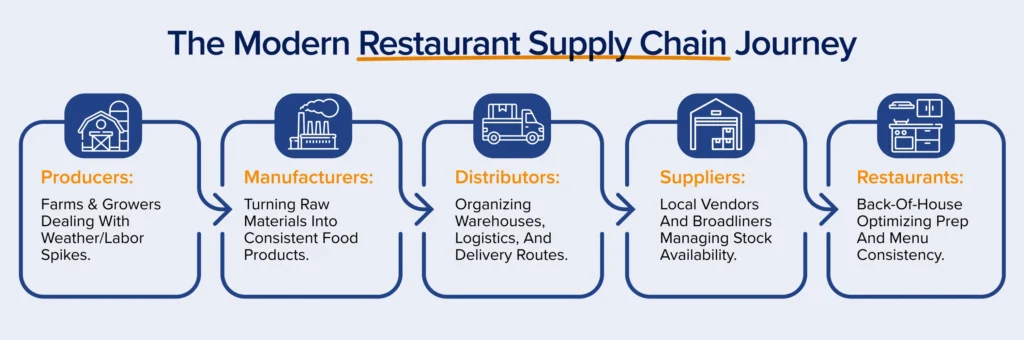
Think of your restaurant supply chain as the journey every ingredient takes before it hits a customer’s plate. It is the entire web of people, companies, and transportation required to get product from the source to your kitchen. For an independent operator, this includes farms, manufacturers, broadline distributors, specialty vendors, and your own internal purchasing team. When one link in this chain kinks, your food costs skyrocket and your prep team feels the pressure.
The Key Players in Restaurant Supply Chain Management
To fix a system, you have to know who is running it. Each player impacts your bottom line:
Food Producers
Food producers are the starting point of the restaurant supply chain. These are farms, fisheries, ranches, and growers that supply raw ingredients like produce, meat, dairy, and seafood.
When weather issues, disease outbreaks, fuel costs, or labor shortages affect producers, restaurants often see the impact in the form of price spikes or limited availability.
Manufacturers
Manufacturers take raw ingredients and turn them into finished or semi-finished products. That might include sauces, frozen items, baked goods, portioned proteins, packaged snacks, or disposable products.
Manufacturers are a major part of the restaurant supply chain because they influence consistency, product availability, and pricing. If a manufacturer has production delays or packaging shortages, that can ripple across the entire operation.
Distributors
Distributors move products from producers and manufacturers to restaurants. They handle warehousing, logistics, order fulfillment, and delivery schedules.
For many operators, distributors are the most visible part of the restaurant supply chain because they’re the partners restaurants interact with most often. A dependable distributor relationship can help reduce stockouts, improve forecasting, and make ordering more efficient.
Suppliers
Suppliers can include broadline distributors, specialty vendors, local providers, beverage reps, and companies that support everything from janitorial goods to paper products.
In a restaurant supply chain, suppliers are more than order-takers. The right supplier partners can help with product alternatives, pricing conversations, and planning around shortages before they become major problems.
Restaurants
Restaurants are the final link in the restaurant supply chain, but they also play a central role in how well the whole system works.
Ordering habits, menu design, inventory discipline, communication between back-of-house and purchasing teams, and how quickly operators respond to changes all affect supply chain performance. Even the best supplier network can only do so much if ordering is inconsistent or inventory isn’t being tracked closely.
Why Supply Chain Efficiency is Vital for Restaurants
Margins in our industry are razor-thin. If you’re fighting for a 3% to 5% profit margin, you can’t afford sloppy purchasing. An efficient restaurant supply chain means predictable food costs, consistent quality, and a kitchen that runs like clockwork. When you buy smarter, you put cash back into your business.
The Biggest Restaurant Supply Chain Challenges in 2026
Running a kitchen right now isn’t for the faint of heart. Here is what independent operators are battling:
Rising Food Inflation and Ingredient Costs
Food costs continue to be one of the biggest pressures on the restaurant supply chain.
Operators are seeing ongoing volatility in proteins, dairy, oils, produce, and imported goods. Even when pricing doesn’t spike dramatically, steady increases over time can quietly eat away at margins. For restaurants that don’t review purchasing trends regularly, it’s easy to fall behind.
Supply Chain Disruptions and Product Shortages
Disruptions still happen for all kinds of reasons – weather events, transportation bottlenecks, global sourcing issues, plant shutdowns, and regional shortages.
In a restaurant supply chain, a shortage doesn’t have to affect every product to cause real trouble. If just one high-use ingredient becomes unavailable, it can force menu changes, purchasing workarounds, and higher substitute costs.
Labor Shortages Across Distribution and Logistics
Labor shortages continue to affect trucking, warehousing, manufacturing, and food production.
That means the restaurant supply chain can slow down even when product technically exists. A vendor may have inventory, but if staffing is tight in the warehouse or on delivery routes, orders can still arrive incomplete or late.
Delivery Delays and Unpredictable Lead Times
Lead times aren’t always what they used to be. Some products that were once easy to get with a standard delivery window now require more planning.
For operators, that makes the restaurant supply chain harder to manage day to day. Without clear visibility into what’s coming and when, restaurants are more likely to over-order, under-order, or rely on expensive emergency purchases.
Inventory Waste and Overstocking Problems
Look, we’ve all been there: you get burned by a product shortage once, and suddenly you’re over-ordering just to sleep better at night. Nobody wants to be the chef explaining to a guest that the best-seller is off the menu, so you stock up “just in case.”
But here’s the reality: that safety net is actually a trap. When you overstock, you’re creating a cycle of waste that hits your bottom line in three ways:
- The Spoilage Creep: Ingredients sitting in the walk-in aren’t just taking up space, they’re on a timer. Produce goes soft, proteins lose their edge, and by the time you actually need them, you’re often just moving them from the shelf to the trash.
- The Storage Squeeze: When your walk-in is packed to the ceiling, the organization goes out the window. You end up shuffling cases just to find what you need, losing track of older inventory, and creating a disorganized mess that slows down your prep team during the dinner rush.
- Frozen Cash: Every dollar sitting on a shelf as excess inventory is a dollar that isn’t being used for payroll, rent, or maintenance. You can’t pay your bills with extra cases of chicken wings.
Ultimately, poor inventory control is rarely a one-time failure-it’s a slow bleed. It hides behind the guise of “playing it safe,” but in reality, it’s one of the most expensive headaches in the restaurant supply chain. You aren’t just managing food; you’re managing cash flow, and sloppy inventory is the fastest way to watch your margins slide straight into the bin.
Heavy Dependence on Single Suppliers
Let’s be real: putting all your eggs in one vendor’s basket is a massive gamble in this industry. When you lean too hard on a single source, you’re basically handing over the keys to your kitchen and hoping they don’t lose them.
If that supplier hits you with a sudden price hike, a shipping delay, or an “out-of-stock” notification right before the Friday dinner rush, you’re the one stuck scrambling. You end up 86ing crowd favorites and apologizing to guests because you’re left with no backup plan. It’s not just a headache; it’s a direct hit to your bottom line.
A resilient supply chain gives you the breathing room to handle these surprises. It’s about having a second option on speed dial for your high-volume items so you’re never left high and dry.
Building that kind of reliability starts with vetting the right partners. If you’re ready to start diversifying your vendor list, check out our guide on How to Find Reliable and Affordable Restaurant Suppliers for some real-world advice on finding partners who will actually have your back.
Restaurant Supply Chain KPIs Every Operator Should Track
If you aren’t measuring your numbers, you’re essentially flying blind. You don’t need a finance degree to run a tight ship, but you do need a handful of core metrics that act as early warning systems. Tracking these KPIs allows you to spot supply chain friction, tighten your purchasing habits, and protect your margins before a small problem becomes a business-threatening disaster.
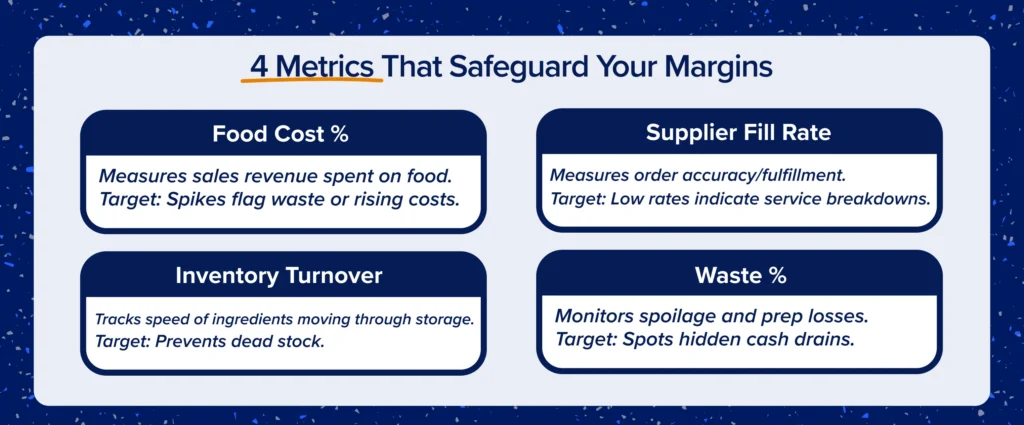
Food Cost Percentage
This is the “truth-teller” of your P&L statement. It tells you exactly how much of every sales dollar is being consumed by your ingredients. When this number creeps upward, it’s a red flag indicating potential issues: vendor price hikes, sloppy portioning on the line, product theft, or a menu mix that isn’t pulling its weight. Don’t wait for your end-of-month statements to catch a margin hit-track this weekly to make informed adjustments in real-time.
Supplier Fill Rate
Think of fill rate as your distributor’s report card; it measures how much of your order actually arrived at your back door as requested. A consistently low fill rate isn’t just an annoyance-it’s a massive operational drain. When your supplier falls short, your team is forced to scramble, hunting for retail replacements or improvising mid-service. If your fill rate is shaky, you’re losing money on labor and ingredient consistency. It’s a sign that you need to either demand better performance or start sourcing a new partner.
Inventory Turnover
Your storage room should be a high-velocity zone, not a graveyard for forgotten stock. Inventory turnover tracks how quickly your product moves through the house. Healthy turnover means your ordering is synced with actual demand, keeping your ingredients fresh and your cash flow moving. If turnover is sluggish, you have too much capital tied up in inventory that is sitting, spoiling, or becoming obsolete. This metric is your gut-check on whether your purchasing is actually aligned with your kitchen’s daily reality.
Waste Percentage
Waste is the “silent killer” of restaurant profitability. It captures everything that never makes it to a guest’s plate: spoilage, over-prepped items, trim loss, and damage. Because it often happens out of sight, it’s easy to ignore, but it drains profit even during your busiest months. High waste is almost always a symptom of a larger, fixable issue-poor forecasting, bad prep habits, or lack of storage discipline. Start logging your waste to identify exactly where the leaks are in your profit pipeline.
How Technology Is Improving Restaurant Supply Chain Management
Nobody opened a restaurant to spend their nights buried in spreadsheets, hunting down missing invoices, or playing phone tag with vendors at 2:00 AM. For too long, managing a supply chain meant relying on guesswork, clipboard-counting, and a healthy dose of crossed fingers.
The good news? Modern technology isn’t about adding another layer of “corporate” software to your already overflowing plate. It’s about automating the brain-melting busywork so you can stop babysitting orders and start focusing on the floor. The right tools turn your supply chain from a chaotic game of “whack-a-mole” into a predictable, manageable system.
Real-Time Visibility Across the Supply Chain
In the restaurant business, surprises are almost never a good thing-especially when they happen during a busy dinner shift. Real-time visibility acts as a pulse for your back-of-house, giving you a clear view of your orders, deliveries, inventory levels, and supplier activity as it happens.
Why this matters for your operations:
- Avoid the “Mid-Service Scramble”: Instead of realizing at 4:30 PM that your weekend protein delivery is short, you get the alert hours earlier. That lead time is a lifesaver, giving your team the breathing room to pivot the menu, swap out a special, or hit a local backup supplier before the first guest even walks through the door.
- Proactive vs. Reactive: Most supply chain headaches are only expensive because they catch you off guard. With live data, you aren’t just “finding out what went wrong”; you are adjusting to market conditions, vendor delays, and demand shifts before they ever reach the dining room.
- Data-Driven Decisions: You can track stock levels and expiration dates based on your actual sales pace-not a gut feeling or a mental note that someone forgot to write down.
Ultimately, real-time visibility isn’t a luxury feature reserved for massive corporate chains. It is the baseline expectation for any operator who wants to stop fighting daily fires and start steering their business with confidence. It allows your team to stop improvising on the fly and start executing a plan, ensuring your margins stay protected and your guests get the consistent experience they expect.
Data Analytics for Smarter Purchasing Decisions
Good purchasing decisions shouldn’t rely on guesswork.
Data analytics helps restaurants spot pricing trends, track product usage, compare vendors, and understand where ordering patterns may be off. In a restaurant supply chain, better data leads to better buying – especially when every point of margin matters.
Supplier Tracking and Performance Monitoring
Technology can also help restaurants monitor supplier performance over time.
That includes order accuracy, fill rates, pricing changes, substitutions, and delivery consistency. Having that information in one place gives operators a stronger position when reviewing vendor relationships and making changes in the restaurant supply chain.
Automated Ordering and Procurement Workflows
Manual ordering takes time and leaves room for mistakes.
Automated workflows can help standardize ordering, reduce missed items, and make purchasing more consistent across locations or dayparts. In a busy restaurant supply chain, even small improvements in ordering discipline can create meaningful savings.
Early Detection of Supply Chain Disruptions
Some technology platforms can flag unusual pricing changes, product shortages, or ordering disruptions early.
That early warning matters. In the restaurant supply chain, the sooner operators know there may be a problem, the more options they have to shift suppliers, adjust menus, or buy strategically instead of scrambling at the last minute.
Best Practices for Building a More Resilient Restaurant Supply Chain
A resilient restaurant supply chain doesn’t happen by accident. It comes from tightening up processes, building stronger vendor relationships, and planning ahead instead of always reacting.
Diversify Suppliers to Reduce Risk
Putting too much volume with one source creates vulnerability.
A smarter approach is to diversify suppliers where it makes sense, especially for core items and high-risk categories. That doesn’t mean making purchasing more complicated than it needs to be. It means having options when availability, service, or pricing changes.
Build Stronger Relationships With Food Distributors
Distributors can be valuable partners when communication is strong.
The better your relationship, the easier it is to work through substitutions, understand market conditions, and get ahead of problems before they hit the line. A resilient restaurant supply chain depends on real partnership, not just transactions.
Standardize Purchasing and Ordering Processes
Inconsistent ordering creates avoidable problems.
Restaurants should have clear processes around who orders, when they order, what par levels are used, and how substitutions are approved. Standardization helps the restaurant supply chain run with fewer surprises and makes inventory easier to manage.
Review Supplier Pricing Regularly
Supplier pricing should never be set on autopilot.
Restaurants need to review pricing often enough to spot increases, compare options, and challenge costs when needed. In a tight-margin business, regular review is one of the simplest ways to keep the restaurant supply chain from becoming more expensive than it needs to be.
Create Backup Plans for High-Risk Ingredients
Every operator has a few items that would cause serious problems if they disappeared overnight.
Identify those products and build backup plans in advance. That could mean approving substitute specs, lining up secondary suppliers, or adjusting recipes if certain ingredients become too expensive or unavailable. This kind of planning makes the restaurant supply chain much more resilient.
Improve Communication Between Kitchen and Purchasing Teams
Supply chain problems often get worse when teams operate in silos.
If the kitchen changes usage patterns but purchasing doesn’t know, or if product issues show up in receiving and never get communicated, costs climb fast. Better communication keeps the restaurant supply chain aligned with what’s actually happening in the operation.
Practical Ways Restaurants Can Cut Supply Chain Costs
Cost control doesn’t always require a major overhaul. In many cases, restaurants can improve the restaurant supply chain by tightening up a few habits and making smarter day-to-day decisions.
Reduce Emergency and Rush Orders
Rush orders usually cost more, create stress, and point to a planning gap somewhere in the system.
Improving order schedules, setting better pars, and watching usage trends more closely can reduce those last-minute purchases. A more organized restaurant supply chain naturally leads to fewer expensive surprises.
Focus on High-Margin Menu Items
Menu strategy affects supply chain performance more than many operators realize.
When restaurants promote high-margin items that use efficient, easy-to-source ingredients, they put less pressure on the restaurant supply chain and improve profitability at the same time. This is especially helpful when certain products are volatile or hard to source consistently.
Minimize Food Waste Across Operations
Waste reduction is one of the fastest ways to improve margins.
That means looking at prep loss, spoilage, portion control, overproduction, and unused ingredients. When restaurants reduce waste, the restaurant supply chain becomes leaner, more efficient, and less expensive to manage.
Negotiate Better Supplier Agreements
Too many operators accept supplier pricing and terms at face value.
But there may be room to improve rebates, contract pricing, delivery terms, or product alternatives. A better supplier agreement can strengthen the restaurant supply chain while lowering overall cost pressure.
Monitor Food Costs and Purchasing Trends Weekly
Monthly reviews are helpful, but weekly monitoring gives operators a much better chance to respond quickly.
When you track food costs and purchasing trends every week, it becomes easier to catch unusual price movement, identify overspending, and adjust orders before small issues become expensive ones. That level of attention keeps the restaurant supply chain under control.
Final Thoughts
Let’s be clear: there is no such thing as a “perfect” restaurant supply chain. In this industry, the only constant is change. Prices spike, deliveries go sideways, and product shortages can turn a routine shift into a logistical nightmare.
The operators who consistently survive-and thrive-aren’t just “getting lucky.” They are the ones who have stopped winging it. They are proactive about watching their numbers, keeping their distributors honest, tightening up ordering protocols, and refusing to rely on a single source of supply. They treat waste as a “slow leak” in their margin and act quickly to plug it.
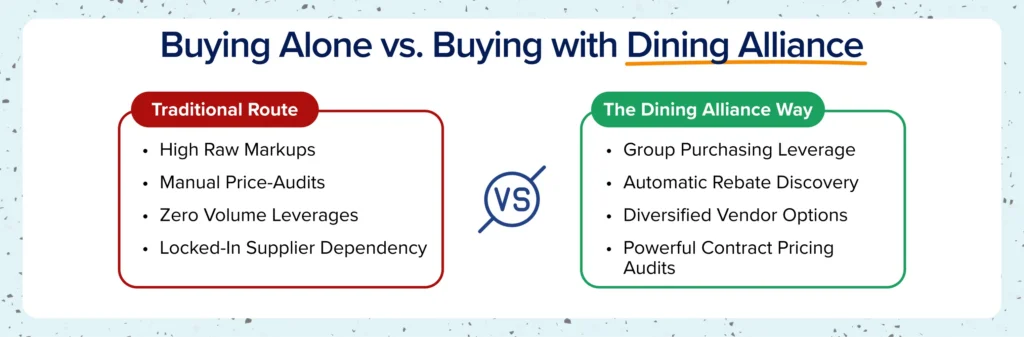
At Dining Alliance, we understand that independent operators don’t need more complex software or corporate theory. You need practical tools that offer leverage, buying power, and stability. A stronger supply chain isn’t about building something bulletproof; it’s about building something that keeps your doors open, your kitchen running, and your margins protected, even when the market gets unpredictable.