

Artificial intelligence can feel like something reserved for tech companies, not restaurants — until you realize how many of the products you order each week have already been touched by it. Long before proteins are trimmed or produce is packed, smart systems are quietly watching production lines, flagging packaging issues, tracking equipment wear, and helping suppliers anticipate demand so food moves more smoothly from plant to plate.
For independent restaurant operators, none of this feels flashy. But the impact is real. Better production oversight means steadier deliveries, fewer rejected cases, stronger food safety controls, and less unpredictability in pricing and availability. AI isn’t removing challenges from the industry — it’s helping tighten the controls that keep small issues from turning into major headaches downstream.
Why the Food Industry is Turning to AI
Food manufacturing has always run on tight margins and tighter schedules. Today’s environment adds even more pressure: labor shortages, stricter compliance standards, transportation volatility, and constantly shifting ingredient costs.
Traditional methods — manual inspections, clipboards, after-the-fact audits — aren’t enough to manage this level of complexity anymore. AI gives producers real-time visibility into what’s happening while production is still moving, not days or weeks later.
This early insight lets teams correct problems before shipments leave the facility. The benefit to operators is simple: fewer sudden outages, fewer substitutions showing up unexpectedly on trucks, and more reliable ordering weeks.
What AI in Food Production Means
When people talk about AI in food production processes, they’re really talking about visibility — more awareness of what’s happening on the line in real time. It isn’t about replacing workers or automating entire facilities. It’s about giving production teams extra eyes where constant monitoring is simply impossible for humans alone.
Facilities rely on tools like:
- Visual scanning systems
- Equipment sensors
- Predictive maintenance software
- Digital traceability platforms
All of it works together to keep tabs on daily operations. Instead of waiting until a supervisor spots an issue or an end-of-shift report gets reviewed, teams get notified the moment something feels “off.” Sometimes it’s a temperature creeping upward. Other times it’s a seal that doesn’t look quite right or a sanitation routine that falls behind. Catching those moments early gives crews time to fix problems before they reach finished product or inbound trucks.
Areas Where AI Is Transforming Food Production Processes
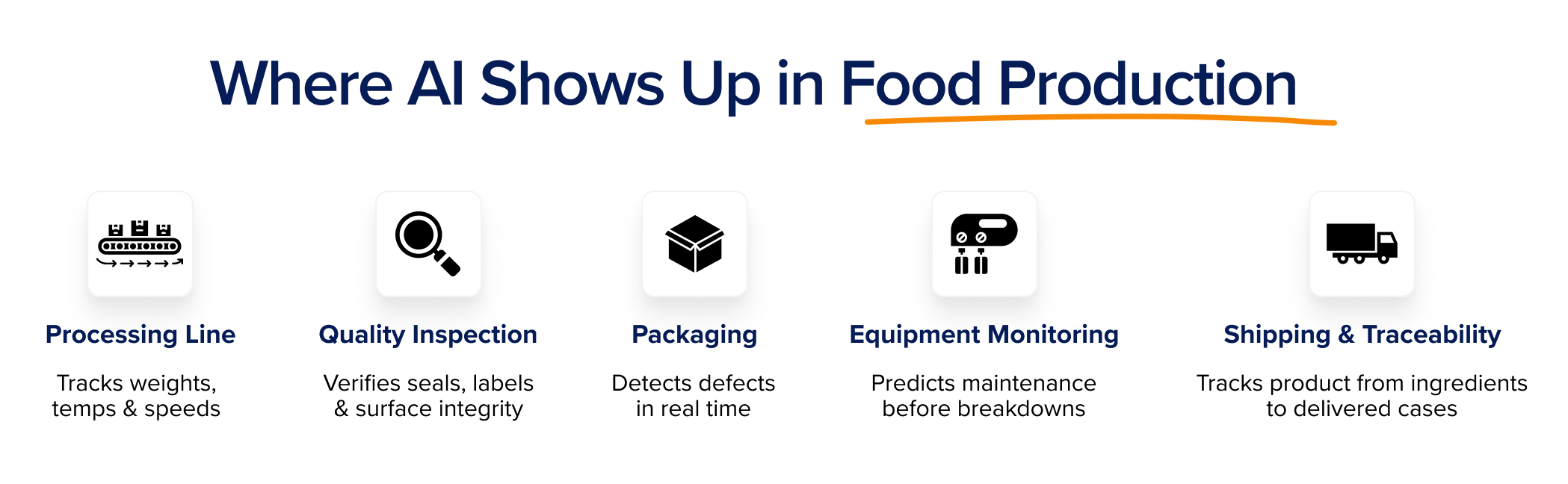
Food Processing Lines
Across active processing lines, AI tracks weights, temperatures, line speeds, and timing as products move along. When numbers drift outside acceptable ranges, adjustments can happen immediately instead of after an entire run is complete and packaged.
Results operators notice include:
- Fewer off-spec portions
- More uniform case packs
- Lower rejection rates upon delivery
Quality Inspection
Visual scanning doesn’t stop when a human shift ends. Camera systems continue verifying labels, seals, and surface conditions from start to finish.
The impact in kitchens looks like:
- Fewer broken or open seals
- Fewer mislabeled items
- Less scrambling during prep when deliveries come in
Production Machinery
Rather than waiting for equipment to fail in the middle of a run, monitoring software watches vibration and heat patterns that signal wear long before a breakdown occurs.
That means:
- Maintenance gets scheduled instead of rushed
- Unplanned downtime is reduced
- Shipments stay on schedule instead of getting pushed back
Food Waste
Food waste rarely shows up as one big loss. It’s usually dozens of tiny leaks — trimming inconsistencies, packing mistakes, or batches aging out before shipping windows close. AI gathers those losses into a single picture so producers can fix what’s truly causing waste instead of making broad cuts that risk hurting quality or consistency.
Production Efficiency
Instead of guessing at what the market might need weeks from now, AI pulls from real purchasing behavior and live trend data to line production up with what restaurants are actually ordering. That shift alone takes a lot of the volatility out of the supply chain — fewer late surprises and fewer moments where product availability swings too far in either direction.
That translates into:
- Fewer sudden swings that leave products either short or oversupplied
- More consistent availability from week to week
- Fewer “boom or bust” inventory cycles that force restaurants into substitutions or over-ordering
How AI Improves Food Safety and Compliance
Real-Time Monitoring of Hygiene Standards
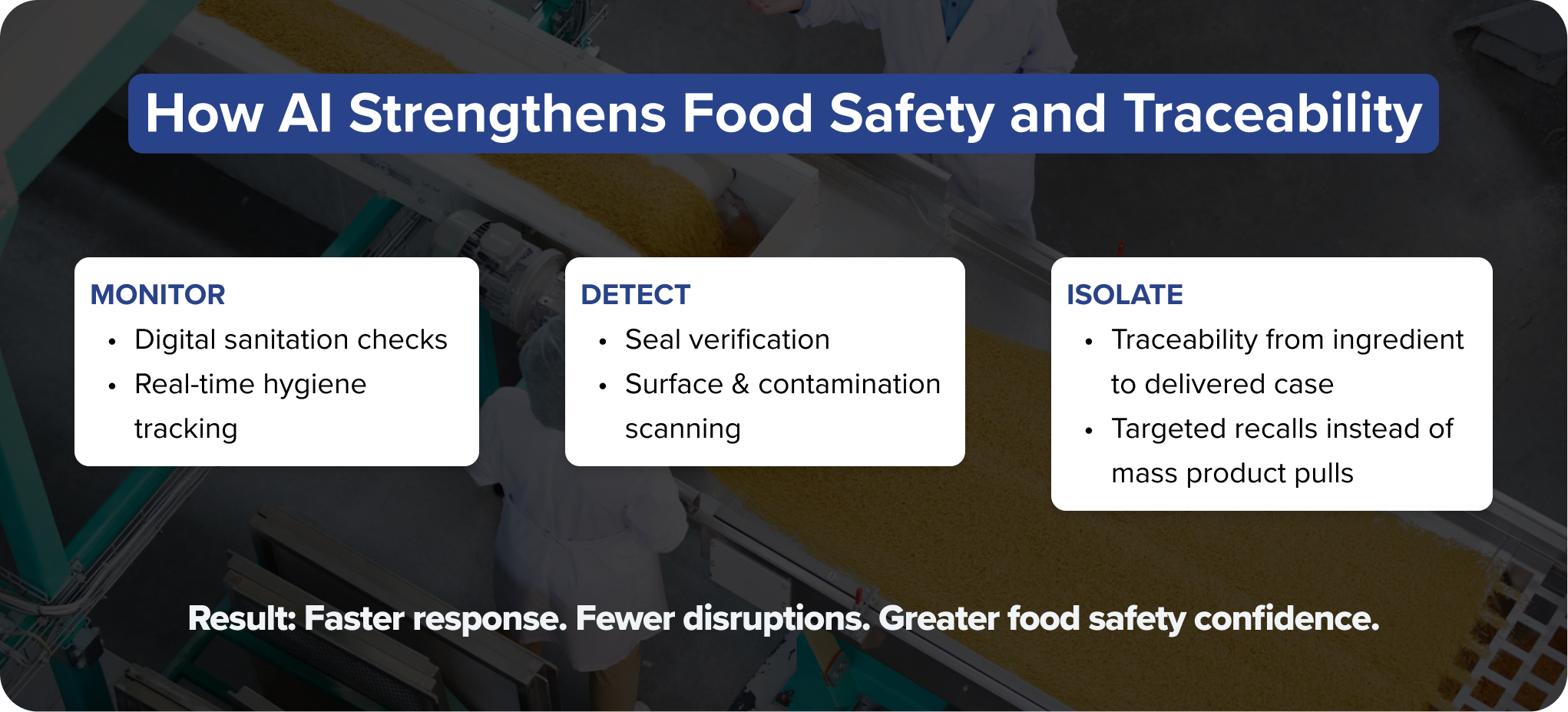
Sanitation tracking no longer lives on clipboards taped to walls or checklists filled out at the end of a long shift. Cleaning steps are verified digitally as they happen. If something gets skipped, rushed, or delayed, alerts let supervisors know immediately — so problems are dealt with on the spot instead of being discovered later during inspections or audits.
Early Detection of Contamination Risks
Scanning tools monitor packaging integrity, surface consistency, and other indicators faster than manual inspection teams can sustain. Potential issues are stopped inside facilities instead of being discovered later at distribution centers or restaurant docks.
End-to-End Traceability Across the Supply Chain
It allows suppliers to follow product through every step, from raw ingredients to delivered cases. So if something comes up, they aren’t yanking entire product lines off trucks. They can isolate what actually needs attention and keep everything else moving.
This allows for:
- Narrow, precise recalls rather than mass product pulls
- Faster response times when concerns arise
- Less unnecessary inventory disruption for operators
Automated Safety Reporting and Audits
Compliance tracking no longer depends on piles of paper forms collected after the fact. Records are built automatically as production moves forward across shifts and facilities. Audits tend to happen faster because documentation is already organized, and shipping delays caused by missing paperwork are far less likely.
Operational and Business Benefits of AI in Food Production Processes
Lower Production Costs
When unplanned breakdowns happen less often and production schedules tighten up, operating costs don’t spiral as easily. Less rework, fewer emergency repairs, and smoother workflow all add up to more stable spending — which eventually supports steadier pricing down the line.
Reduced Food Waste
AI helps producers see exactly where product loss occurs instead of relying on estimates. That clarity makes it easier to tighten up waste without trimming corners or lowering quality standards.
Consistent Product Quality
Automation supports:
- Uniform portion sizing
- Accurate labeling
- Consistent packaging closure
- Reliable product appearance
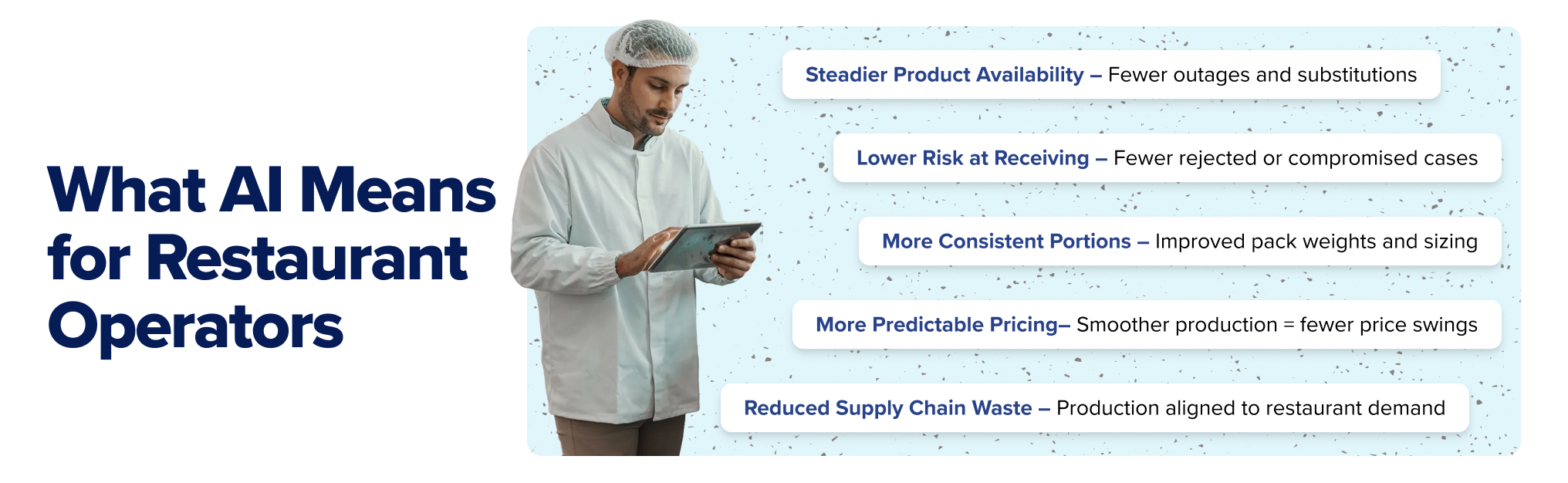
All of this means fewer surprises once cases are opened in the kitchen — fewer off-weight portions, fewer label questions, fewer prep adjustments at the last second.
Better Demand Forecasting
Producers can get their production volumes closer to what restaurants really need by looking at past buying patterns and the current state of the market. This is especially useful when demand is harder to predict from week to week, like during promotions or when the menu changes with the seasons.
Sustainability Impact of AI in Food Manufacturing
Reducing Carbon Footprint and Energy Usage
Better scheduling keeps equipment running only when it’s truly needed while reducing idle operation and wasted energy.
Smarter Resource Management and Water Conservation
AI helps optimize water use during sanitation workflows so cleaning remains thorough without excess waste.
Supporting Sustainable Food Production Goals
Lower waste output, improved energy efficiency, and tighter resource management all help facilities stay aligned with sustainability expectations.
Challenges of Using AI in Food Production Processes
High Implementation and Infrastructure Costs
Technology investments require real capital upfront, particularly for plants operating with older equipment.
Integration with Legacy Systems
Older machinery often requires customized upgrades to connect with modern digital platforms.
Lack of Skilled Workforce
Teams must understand both production equipment and data tools, a staffing challenge in a tight labor market.
Data Accuracy and System Reliability
Performance depends on data quality inputs. Errors or gaps limit system effectiveness.
Ethical and Privacy Concerns
Digital connectivity brings greater responsibility around data security and privacy protection.
How to Overcome AI Adoption Challenges
Build a Strong Data Infrastructure
Reliable connectivity and consistent data collection create a foundation for AI success.
Upskill Employees
Training helps workers trust alerts and understand how to act on AI insights.
Start with Pilot Projects
Smaller rollouts prove value before expansion across facilities.
Choose Scalable AI Solutions
Flexible platforms can grow as operational needs expand.
Partner with AI Experts
Outside technology partners help lower risk and accelerate adoption.
How to Get Started with AI in Food Production
Identify the Right Processes
Most facilities begin with:
- Sanitation verification
- Inspection automation
- Maintenance forecasting
Select Suitable AI Tools
Food-focused platforms typically integrate more smoothly than broad general-purpose analytics software.
Plan Phased Implementation
Gradual adoption keeps operations running without disruption.
Measure Performance and ROI
Results are tracked through:
- Food safety improvements
- Reduced waste
- Increased equipment uptime
- Better supply stability
Real-World Applications of AI in Food Production
Food and Beverage Manufacturing
Bottle fill monitoring, sanitation tracking, packaging inspections.
Meat and Seafood Processing
Automated portion grading, contamination scanning, seal verification.
Packaged and Processed Foods
Batch traceability platforms and early defect detection systems.
Bakery and Confectionery Production
Dough consistency analysis, oven calibration monitoring, packaging quality checks.
Future of AI in Food Production Processes
As technology gets easier to use and cheaper, more and more mid-sized and specialty food manufacturing facilities are adopting it. Restaurants benefit indirectly over time from smoother sourcing, faster recall responses, steadier supply flow, and better cost predictability, all without making operations more complicated.
Frequently Asked Questions (FAQs)
Is AI safe for food manufacturing processes?
Yes. AI strengthens sanitation verification and inspection consistency while supporting human oversight.
Can small food manufacturers adopt AI?
Many start with pilot tools focused on a single process before expanding systems gradually.
Does AI reduce food production costs?
Most facilities see savings from efficiency gains and waste reduction well before systems reach full scale.
Will AI replace human workers in food factories?
No. AI supports workers by handling repetitive monitoring tasks while teams focus on safety decisions and hands-on equipment management.
What are the biggest challenges of AI in food production?
The most common hurdles include:
- Upfront investment requirements
- Workforce training needs
- Integration with older equipment
- Maintaining consistent data quality
What This Means for Independent Operators
Food production is evolving fast, but independent restaurants shouldn’t have to chase technology trends to keep up.
Dining Alliance helps operators turn upstream innovation into smarter purchasing strategies, stronger supplier relationships, and more confident cost control so you can focus on running a successful restaurant instead of navigating supply chain chaos.